
Choosing the water purifier can be confusing, especially when there are different technologies such as RO, UV, and UF. Each purification method works differently and is suitable for different types of water.
Many homeowners search for RO vs. UV vs. UF water purifiers, which is better, whether UV water purification is good for health, whether UF is needed with RO, and whether UV or UF can reduce TDS.
The answer depends mainly on your water source, TDS level, and water quality. Understanding the difference between RO, UV, and UF can help you choose a water purifier that matches your home’s requirements.
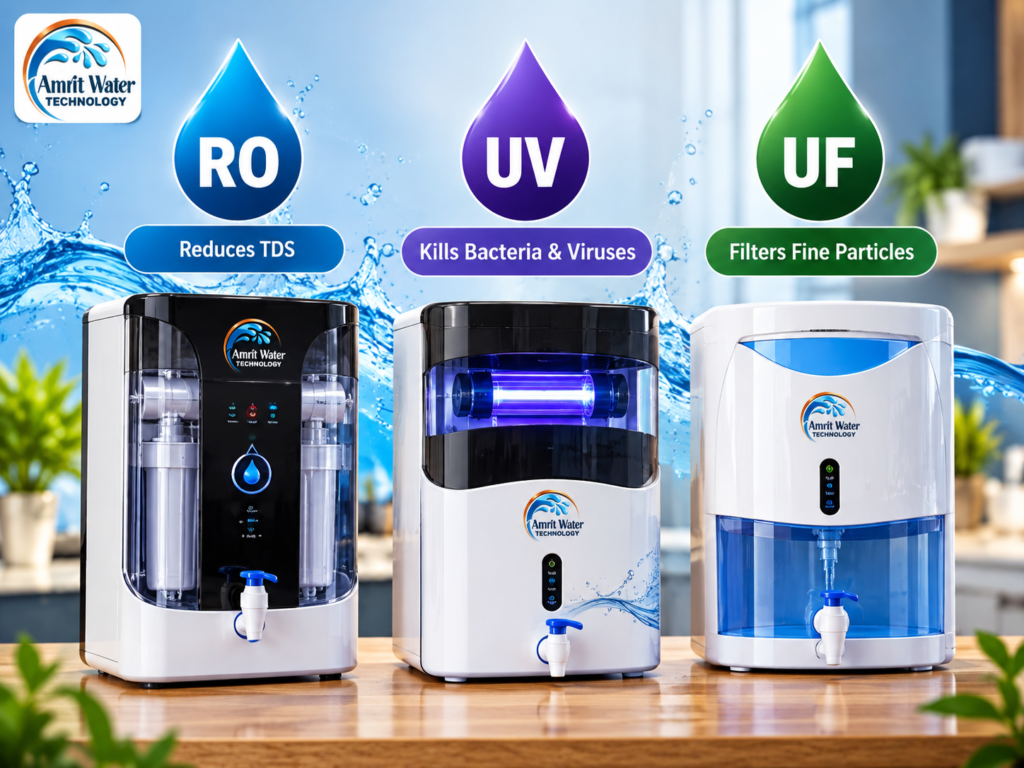
What Is RO in a Water Purifier?
RO stands for Reverse Osmosis. It is a purification technology that uses a permeable membrane to reduce dissolved impurities from water.
RO can help reduce:
- Dissolved salts
- High TDS
- Heavy Metals
- Fluoride and other dissolved contaminants
- Various unwanted substances depending on the membrane and system
This makes RO particularly useful where the water has TDS, such as some borewells, groundwater, or mixed water sources.
However, RO also produces reject water. Can remove some naturally occurring minerals along with unwanted dissolved substances. Therefore, the purifier should be selected according to the water quality rather than assuming that RO is necessary for every home.
What Is UV in a Water Purifier?
UV stands for Ultraviolet. UV purification uses light to inactivate microorganisms such as certain bacteria and viruses.
Unlike RO, UV purification does not remove salts from water.
This means that if your main concern is TDS, a UV purifier by itself may not be sufficient.
UV can be useful as part of a purification system when microbiological contamination is a concern and the incoming water does not require reduction of dissolved solids.
What Is UF in a Water Purifier?
UF stands for Ultrafiltration. UF uses a fine membrane to filter certain suspended particles and microorganisms. Unlike RO, UF generally does not reduce salts and therefore does not significantly reduce TDS.
UF can be useful for water that has low TDS but requires additional filtration.
What Are RO, UV, and UF TDS in a Water Purifier?
One of the common questions people ask concerns RO, UV, UF and TDS.
TDS stands for Total Dissolved Solids. TDS represents the amount of substances that are dissolved in water.
- RO: Can significantly lower TDS.
- UV: Does not lower TDS.
- UF: Does not significantly lower TDS.
Therefore, picking a UV or UF purifier just because it has technology does not guarantee it will fix a high TDS problem.
Does RO Water Reduce TDS?
Yes, RO is made to lower dissolved solids, so RO works well for sources with high TDS.
However, the amount of TDS that RO can remove depends on factors such as:
- Water TDS
- RO membrane condition
- Water pressure
- Purifier design
- Membrane quality
- Filter condition
That is why checking water quality before choosing a purifier is important.
What Does an Alkaline Water Purifier Mean?
You may also see the term alkaline water purifier when comparing RO systems. An alkaline water purifier or alkaline stage is usually designed to raise the pH of treated water by passing it through an alkaline or mineral stage.
It is important to know that alkaline filtration differs from RO, UV and UF purification. The purification technology and the post‑treatment stage have roles.
The priority must always be to treat the water quality correctly.
RO vs UV vs UF Water Purifier Cost
The cost of an RO, UV or UF water purifier can vary a lot depending on the number of purification stages, storage size, membrane quality, brand, installation needs and extra features.
A simple UV or UF system may be less complex than a multi‑stage RO system. Looking only at the initial price is not enough.
You should also look at:
- Filter replacement cost
- RO membrane replacement
- Electricity consumption
- Water wastage
- Installation
- Annual Maintenance
- Availability of service
A purifier that is cheap at first may not be the cheapest over many years.
Which Water Purifier Should You Pick?
Before buying a water purifier, check these points:
1. Test Your Water TDS
TDS testing can show whether your water has a level of dissolved solids.
2. Identify Your Water Source
Is your water supplied through Municipal Supply, Borewell, Tanker or mixed resources? Different sources can have water quality.
3. Check for Water‑Quality Issues
TDS is only one factor. Depending on the water source, other issues may also matter.
4. Choose the Right Technology
Do not pick RO, UV or UF just because one seems advanced. Pick the technology that matches your water quality needs.
5. Think About Maintenance
Filters and membranes must be replaced or serviced regularly. Regular maintenance keeps the purifier working.
Why Professional RO Service Matters
Even a good water purifier can work poorly if filters are blocked or the RO membrane has worn out.
Regular RO service, filter replacement and TDS testing can spot problems before they hurt purifier performance.
For homeowners in Pathankot, Jammu and nearby areas, Amrit Water Technology offers water purifier services such as installation, repair, filter replacement and maintenance.
Why Choose Amrit Water Technology?
Amrit Water Technology helps customers with their water purification needs, including RO water purifier installation, RO repair, filter replacement, TDS testing and maintenance.
Instead of picking a purifier only on price or the number of stages, customers should first assess their water quality and then pick the right system.
Whether you need an RO water purifier for home or need RO service checking water quality, it is a smart first step.
Frequently Asked Questions
Is RO water safe for kidneys?
RO purification can produce purified drinking water by reducing dissolved substances. However, whether RO is appropriate depends on the source water and the purification system. A purifier should be selected according to actual water-quality requirements rather than using RO unnecessarily.
Is UV-UV water good for health?
UV is a purification technology that uses ultraviolet light to inactivate certain microorganisms. Its usefulness depends on the quality of the incoming water and the overall purification system.
Do we need UF with RO?
Not necessarily. Whether UF is useful alongside RO depends on the water quality and the design of the purification system.
Does UV or UF reduce TDS?
Generally, UV and UF do not significantly reduce TDS. RO is the technology commonly used when significant TDS reduction is required.
RO or UV water purifier which is better?
Neither is universally better. RO is generally suited to water requiring dissolved-solids reduction, while UV is useful for microbiological treatment. Your water source and quality should determine the choice.
What is UF in a water purifier?
UF means Ultrafiltration. It uses a membrane to filter fine particles and certain microorganisms but does not significantly reduce dissolved salts or TDS.
Conclusion
When comparing RO vs UV vs UF water purifier, there is no one-size-fits-all answer. RO, UV and UF perform different functions, and the right technology depends on your water source and quality.
If your water has high TDS, RO may be required. If the main concern is microorganisms in otherwise suitable water, UV can be useful. UF can provide additional physical filtration without significantly reducing TDS.
Before purchasing a water purifier, consider TDS testing, water source, purification requirements and long-term maintenance.
For professional guidance, installation, repair, filter replacement and water purifier maintenance in Pathankot and Jammu, Amrit Water Technology can help you choose a suitable purification solution.