
Choosing a home water purifier isn’t just about price or the number of purification stages. The correct choice depends on the water source, the TDS level, and the kinds of impurities that may be in the water.
RO, UV, and UF technologies work in ways, so learning about these technologies can help you pick a water purifier that fits your home’s needs. Current buying guides also advise checking the water quality before deciding which purification technology is suitable.
Why Choosing the Right Water Purifier Matters
Water that comes to homes can come from sources, such as municipal supply, borewell water, tanker water, or a mix of sources. Therefore, the water quality can vary a lot between places.
A TDS test can provide information about how many dissolved solids are in the water. However, TDS alone does not show every contaminant, so it should not be treated as a full water‑quality test.
Before purchasing a purifier, consider:
- Your water source
- TDS level
- Hardness or dissolved impurities
- Microbiological concerns
- Family size and daily water requirement
- Filter and membrane replacement requirements
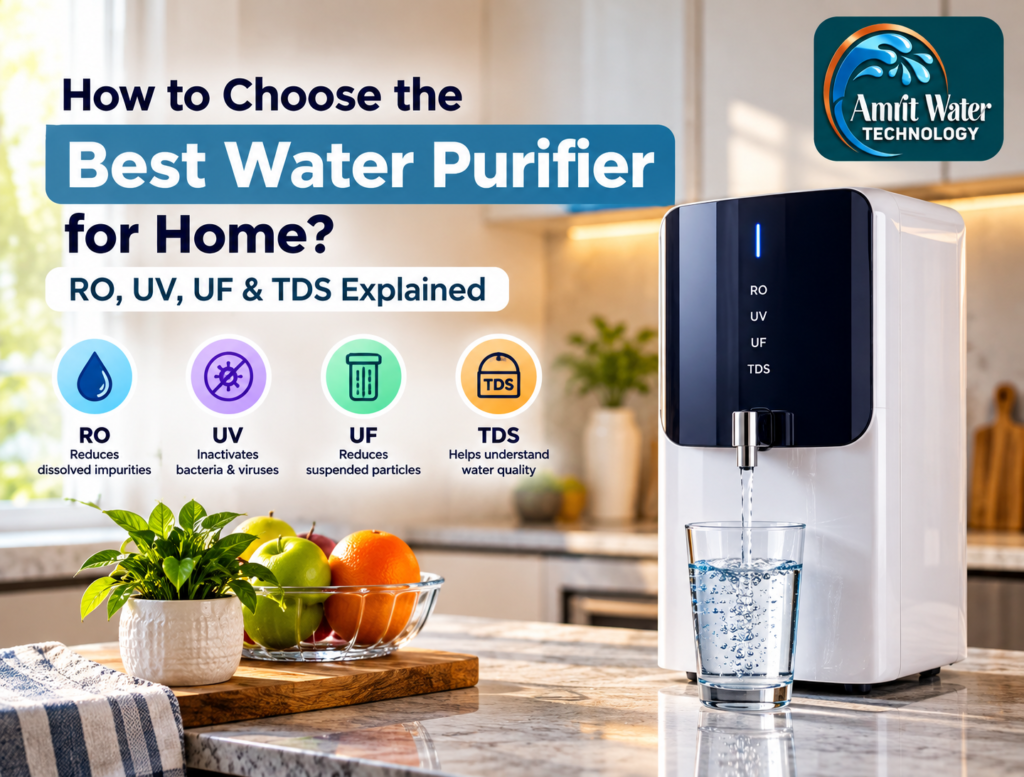
RO vs UV vs UF: Which Water Purifier Is Right for Your Home?
Different purification technologies perform different functions.
RO Water Purifier
Reverse Osmosis (RO) uses a membrane to filter out dissolved salts and other dissolved impurities. RO is often chosen for homes that get water, such as some borewell or tanker supplies.
If the household gets high‑TDS water, an RO‑based system might be a good option. However, the real water quality should be checked before picking a water purifier.
UV Water Purifier
Ultraviolet (UV) purification uses UV light to kill microorganisms such as bacteria and viruses. UV does not lower dissolved salts or TDS.
Thus, UV and RO solve water‑quality problems and should not be treated as the same technology.
UF Water Purifier
Ultrafiltration (UF) uses a membrane to remove suspended particles and some microorganisms. It does not need electricity for filtration. UF does not lower dissolved salts, so it does not replace RO when high TDS is the issue.
RO + UV + UF Purifiers
Some modern systems mix RO, UV, and UF technologies. These systems can give purification steps in one unit, but the best setup still depends on the water quality and source.
Adding purification stages does not automatically make a water purifier suitable for every home.
How TDS Affects Your Water Purifier Choice
TDS means Total Dissolved Solids. Usually refers to dissolved substances such as salts and minerals in the water.
Checking TDS before buying a water purifier can help you see if dissolved solids are an issue. However, a TDS meter cannot show contaminants such as bacteria, viruses, or individual chemicals.
This is why it is better to look at TDS with the water source and other water‑quality data instead of picking a water purifier based only on one number.
What Type of Purifier Is Suitable for Different Water Sources?
Municipal Water
Municipal water can vary depending on the treatment and distribution system. If the water has low dissolved solids, a UV or UF‑based purifier might be suitable depending on the real water‑quality concerns.
Borewell Water
Borewell water can have levels of dissolved solids and hardness in some places. An RO‑based system may be right when tests indicate that dissolved impurities are a problem.
Tanker Water
Tanker water quality can vary with its source and storage conditions. Testing the water before picking a purification system is an idea.
Mixed Water Supply
Some homes get water from more than one source. In those cases the water quality can change with the source that is used. Testing the water can help decide the right purification technology.
What About Water Purifiers Without Electricity?
If you are looking for a water purifier for a home that has no electricity, UF or gravity‑based systems may be options depending on the water quality and purification needs. However, these systems usually cannot lower dissolved salts and TDS like RO does. If high TDS is a concern, a non‑electric purifier may not give the treatment that is needed.
How Much Does a Home Water Purifier Cost?
The water purifier price depends on factors including:
- Purification technology
- Number and type of filters
- Storage capacity
- RO membrane
- UV and UF stages
- TDS controller or mineral-related features
- Installation requirements
- Brand and model
- After-sales service
Instead of picking a water purifier only because it costs less—think about the long‑term cost of filters, membranes, servicing, and maintenance.
When Should You Replace RO Filters and Membranes?
Filters and RO membranes need to be replaced as they are used. The time between replacements may vary with water quality, how often you use the water purifier, and the specific purifier model.
Signs that your purifier may require servicing can include:
- Reduced water flow
- Changes in water taste or smell
- Poor purification performance
- Unusual sounds from the purifier
- Filter or service indicators appearing
- Longer purification time
Regular servicing helps keep the water purifier running well.
How to Choose a Water Purifier Dealer in Pathankot
If you are looking for a water purifier near you in Pathankot, do not consider the price of the water purifier.
Before purchasing, check whether the dealer provides:
- Installation support
- Filter replacement
- RO membrane replacement
- Regular servicing
- Water quality testing
- Genuine replacement parts
- After-sales support
Choosing a water purifier service provider can also make future maintenance and servicing easier.
Why Choose Amrit Water Technology?
Amrit Water Technology offers water purification solutions for homes, offices, and other needs in Pathankot and nearby areas.
The right water purifier depends on your water source and water quality. If you do not know which system is best, have your water tested and talk with a water purifier to make a better decision.
Whether you need an RO water purifier, a filter replacement, a water softener solution, or purifier servicing, professional guidance can help you choose a system that fits your real needs.
Frequently Asked Questions
Which water purifier is best for home use?
There is no water purifier that is perfect for every home. The best choice depends on your water source, TDS, and other water‑quality needs.
Is RO better than UV?
RO and UV perform different jobs. RO is made to lower dissolved impurities, while UV is used to kill microorganisms. The right technology depends on the water problem you need to solve.
Is TDS water suitable for drinking?
A high TDS reading means dissolved solids, but TDS alone does not show which substances are in the water. Water quality should be checked with testing.
Can I use a water purifier without electricity?
Yes, some gravity and UF systems can work without electricity. But they do not lower dissolved salts, like RO systems do.
How do I know which purifier I need?
Begin by finding out your water source and testing the water quality, including TDS when needed. Then choose a purification technology that fits the water conditions, not just a brand or stage count.