
Choosing the right water purifier starts with understanding your water quality. One of the common questions people ask is, “What is the best TDS for a water purifier, and does an RO water purifier reduce TDS?”
Total Dissolved Solids (TDS) measures the concentration of dissolved substances, including minerals and salts, in water. Checking TDS levels can help you learn more about your water but it’s not the only way to know whether water is safe to drink.
At Amrit Water Technology we help people look into water purification options, TDS testing, and water purifier services in Pathankot, Jammu, and surrounding areas.
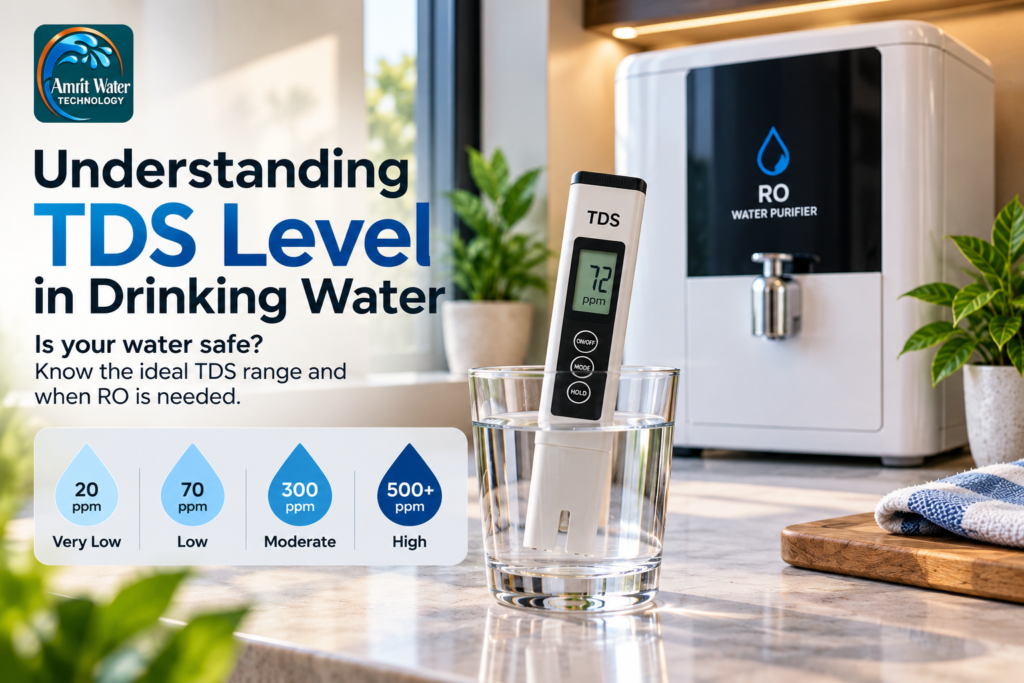
What Is the TDS Level in Drinking Water?
TDS stands for Total Dissolved Solids. It includes minerals, salts, and other things present in water. TDS is generally measured in parts per million (ppm), approximately equivalent to milligrams per litre (mg/L) for these measurements.
The TDS level in a water purifier depends on the source of water. This could be from groundwater, a borewell, or the municipal supply.
Under the Indian drinking water standard IS 10500, the acceptable limit for TDS is 500 mg/L, with a permissible limit of 2,000 mg/L when no alternative source is available.
What Is the Best TDS for a Water Purifier?
There is no single TDS number that guarantees safe drinking water. The right approach is to assess the source water, its chemical and microbiological quality, and the treatment required.
Here is a simple water purifier TDS level chart for general understanding:
| TDS reading | What it indicates |
|---|---|
| Below 50 ppm | Very low dissolved solids; assess the water source and treatment system. |
| 50–150 ppm | Relatively low dissolved solids. |
| 150–300 ppm | Moderate dissolved solids. |
| 300–500 ppm | Higher dissolved solids; check the complete water quality. |
| 500–2,000 ppm | Above the Indian acceptable TDS limit; professional assessment is recommended. |
| Above 2,000 ppm | Exceeds the permissible TDS limit under IS 10500 when no alternative source is available. |
Does an RO Water Purifier Reduce TDS?
Yes. A reverse osmosis (RO) water purifier can reduce salts and many other dissolved substances by pushing water through a semipermeable membrane. The amount of dissolved solids (TDS) that gets reduced depends on the quality of the incoming water, the condition of the membrane, the design of the purifier and how well it is maintained.
Reverse osmosis purification can be helpful when the source water has levels of dissolved salts or when testing shows contaminants that the system is built to remove.
However, reverse osmosis is not something that every household needs. The treatment system should be chosen based on the water quality, not just the TDS level alone.
Water Purifier TDS Level Below 50: Is It Necessary?
Many people look for a water purifier that gives a TDS level below 50 because they think lower TDS always means better water. That is not always correct.
TDS is the amount of dissolved substances in the water. It does not tell the story about the water’s nutritional value or how safe it is. The best way to treat the water depends on the source of water and what’s in it.
If your water purifier has a TDS control or a way to adjust minerals, you should check the settings based on what the manufacturer says and the quality of incoming water.
RO Water TDS Range: How to Pick the Right One?
The appropriate RO drinking water TDS range depends on the incoming water and the performance of the purifier. Instead of targeting an arbitrary number, consider these steps:
- Test the source water for TDS and other relevant contaminants.
- Check whether RO treatment is actually required.
- Select a purifier designed for the identified water quality issues.
- Maintain filters and the RO membrane according to the manufacturer’s schedule.
- Retest the treated water when necessary.
For homes in Pathankot and Jammu, the local water sources and supply conditions can be different. Testing your own water is better than just using a number you find online.
When Should You Get Your Water Tested?
Consider water quality testing if your source has changed, the water has an unusual taste or appearance, your TDS reading changes suddenly, or your purifier’s performance declines.
A TDS meter helps you see how much solids are dissolved. You might need a full test to check for hardness, fluoride, nitrate, heavy metals, and germs depending on the source of water.
Amrit Water Technology offers water purification products and related services. Contact the team to discuss about your water quality requirements and the suitable purification options in Pathankot, Jammu and nearby areas.
Frequently Asked Questions
1. What is the best TDS level for drinking water in India?
India’s IS 10500 standard specifies an acceptable TDS limit of 500 mg/L and a permissible limit of 2,000 mg/L when no alternative source is available. TDS alone cannot confirm drinking water safety.
2. Does an RO filter reduce TDS?
Yes. RO membranes can reduce dissolved salts and many other dissolved substances. Actual reduction depends on the water quality and the purifier’s condition.
3. Is water with 70 TDS better than water with 300 TDS?
Not necessarily. Both readings describe dissolved solids, not every aspect of water quality.
4. Should I choose a water purifier with a TDS controller?
A TDS controller may help adjust the treated water’s mineral content in compatible systems. Choose and configure a purifier based on source water testing and the manufacturer’s recommendations.
5. Where can I get water purifier guidance in Pathankot or Jammu?
You can contact Amrit Water Technology to discuss TDS testing, RO purification, filter maintenance and water treatment solutions for your home or business.
Conclusion
Understanding TDS is an important step towards choosing a suitable water purifier, but the lowest reading is not always the goal. Check your source water, assess other relevant contaminants and choose a treatment system based on the actual water quality.
For water purification guidance, TDS testing and RO service requirements in Pathankot and Jammu, contact Amrit Water Technology to explore a suitable solution for your needs.